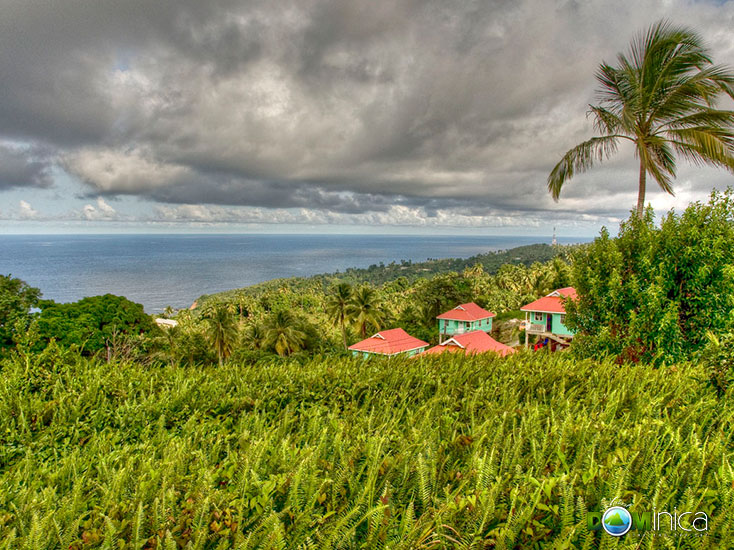
Jean Rhys, who was born in Roseau, set part of her intoxicating
novel Wild Sargasso Sea in her home: "Too much blue, too
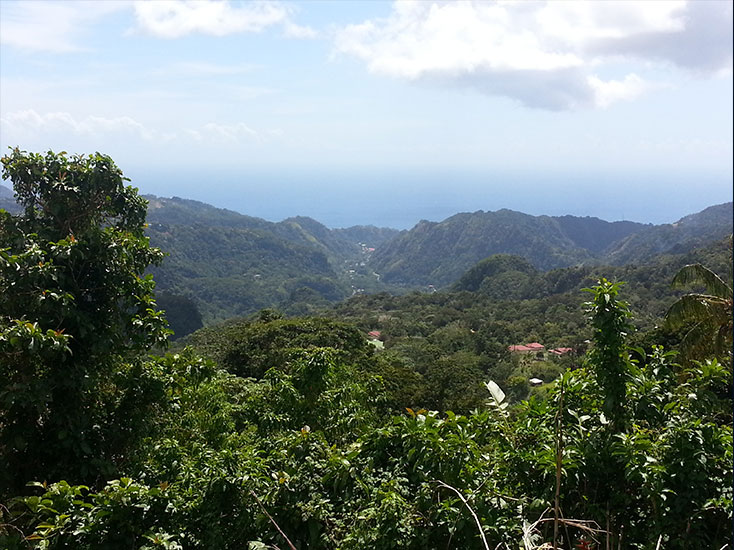
much purple, too much green. The flowers too red, the mountains
too high, the hills too near," said her character, the Englishman
Mr Rochester, as he climbed the track towards his honeymoon home.
But then the island has often overawed European visitors - like
Columbus, the Victorian imperialist J.A. Froude, Patrick Leigh
Fermor - by its physicality, its power to beguile. Sometimes its
beauty makes outsiders uneasy.
To walk around Dominica was a way to learn more about village
life (most Dominicans live on or near the coast) on an island
I had visited many times, since my first trip in 1984 when I went
to see another white Dominican writer, Phyllis Shand Allfrey.
It was her novel, The Orchid House, as luscious as her island,
that had drawn me to Dominica, and to her tiny stone home huddled
in the yellow-green shadows of the Roseau valley.
On that visit I had also interviewed Eugenia Charles, then Prime
Minister and the Iron Lady of the Caribbean. Much later I learned
that in 1935, she and her doctor brother, then a medical student
in Edinburgh, had also walked around the island. Dr Charles wrote
to me about their trip: "Day Four. Off early for more ups
and downs, dipping in the small rivers all of which had to be
forded. There were no real roads, but we reached Marigot just
about sunset. Destination: police station." The Charles'
had taken less time than my 14 days; but perhaps they were fitter,
and they had omitted the west coast. I had no such excuse.
My journey of "ups and downs" began at 5.30 one morning
when I left the comforting wooden frame of Cherry Lodge Guest
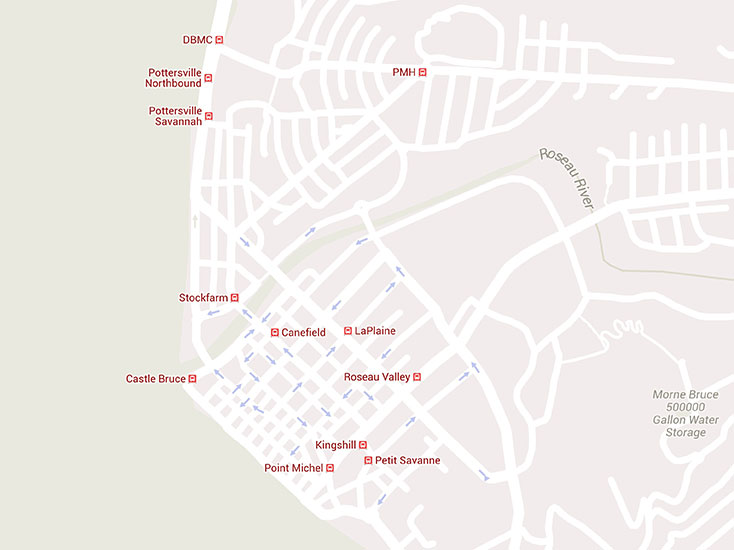
House, the oldest hostelry in Roseau. I headed north towards Canefield
(it once was just that), a rare finger of flat land a small airport,
industrial estate, and new housing that spreads itself on stilts
up the ridges that buttress the dark mountains of the interior.
Where there was once sugar and slavery there are now suburbs for
a new Dominican middle-class, which holidays in Miami and uses
the Internet.
But then Dominica's history would be found at every stopping-place,
in my every encounter. Next to Canefield, for example, are the
two expanding coastal communities of Massacre and Mahaut. Massacre
(pronounced the French way) was close to where Caribs were wiped
out by a posse of English militia in 1674; French families, early
settlers, from Guadeloupe and Martinique, gave the place its name,
a way, perhaps, of embarrassing the English.
And what of crowded, bustling Mahaut? It had evolved after emancipation
when former slaves from the nearby sugar estate squatted on the
only land available to them, a narrow strip of coastal Crown property
known as the Queen's Three Chains. Mahaut still has a huddled
feel. And village life, said a friend, who had prepared me a breakfast
of sweet hot milk and scrambled eggs, continued to be fraught
with a certain mistrust, a legacy, he said, of a divisive plantation
culture.
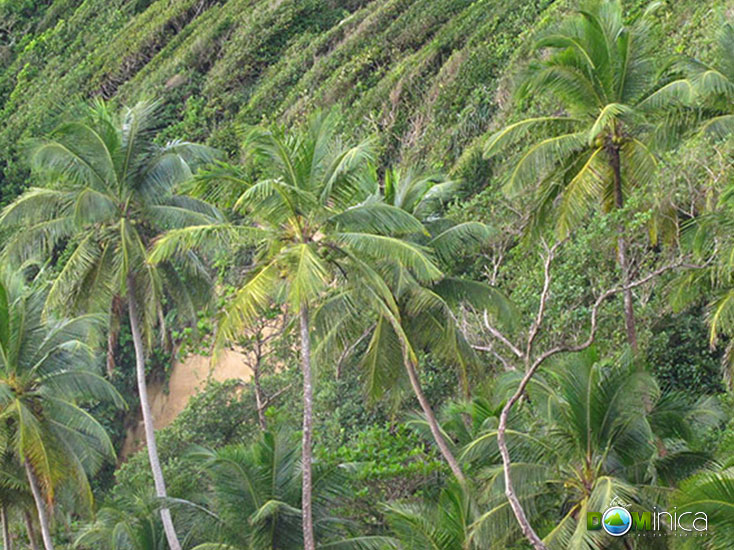
That first morning, through swathes of sunlit coconut and cacao
trees, I reached the mouth of the largest of Dominica's many rivers.
The Layou flows from deep within Dominica. In the dry season,
water courses over boulders like a Scottish salmon river; when
there is heavy rain, it is red, swollen and takes everything before.
Suddenly, past the bridge, the vegetation changed. The cliffsides
were not of dazzling, dancing rainforest but of cactus and thorn
trees. There, on the west coast there is 50 inches of rain compared
to 300 inches in the interior. I stayed that night at the village
of Coulibistrie with a forester, Bertrand Jno Baptiste, his wife,
a pre-school teacher, their two children and Spikey, a Dalmatian
puppy. Despite television, holidays abroad, education, and a sparklingly
modern home, the Jno Baptiste's world is rooted in traditional
ways of doing things.
Bertrand took me to visit his wife's family, to a yard of rural
pastimes: his mother-in-law was picking the fruit off stems of
wild gooseberries (bigger, yellower than the European version),
a young woman was making a broom out of a vine, a cousin ate a
large meal of ground provisions (the ubiquitous root vegetables
of the Caribbean), a child played with a home-made toy. There
were coffee beans to be prepared before roasting so I learned
to "fane" (to split in Creole) the beans, passing them
from hand to hand while blowing on them to remove the chaff.
Such a life is made possible by a close relationship with the
land (national motto: Apwes Bondie c'est la ter, After God it
is the Earth). Even before emancipation, Afro-Dominicans (like
the Caribs before them) were clearing the forest and cultivating
their "gardens"; a strong, independent peasantry emerged,
who remain the backbone of Dominican agriculture.
Bertrand, whose passion is birds, and, in particular, Dominica's
two rare endemic parrots, walked with me to the next community,
Colihaut. He pointed out the coral in the creamy red limestone
strata, circling Caribbean swifts, citronelle grass and sea island
coffee by the roadside. On the road, we found a squashed female
iguana, now a protected species, its eggs spewed out over the
tarmac. Colihaut, like other west coast villages, was there before
the road and seems hidden away. Yet it is a substantial little
place, with Frenchified gingerbread houses and Place Aux Dames,
a former slave market; once the French hung out there conspiring
with the Maroons (the escaped slaves who lived free in the forests)
to bring down the English; in 1828 it had 16 bars and 12 billard
tables. It is the French presence that melded with the African
to produce Dominica's culture (the Creole language, music, dance,
story-telling); while the British, who controlled Dominica for
a far longer period, left their administrative and political system.
Even in the first hour after dawn it was a long hot climb, out
of Colihaut towards Portsmouth, Dominica's second town. Portsmouth
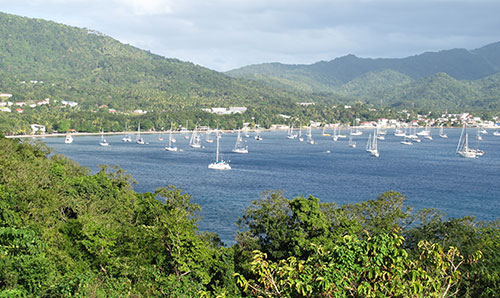
should have been Dominica's first town - its bay is one of the
most stupendous in the Caribbean. But Plymouth never made it -
its swamps were malarial - and it remains a classic second town,
proud and a little stroppy.
The beach at Portsmouth was almost empty. Behind me was the mighty
backdrop of Morne Diablotin and, on the headland, the Cabrits
peninsular whose eighteenth-century British fort sits broodily
in the stillness of the forest. A German woman with a brown baby
on her hip offered me an overpriced lunch. A group of French tourists
waded ashore from a yacht and ate a beach-side picnic. A young
Dominican, his hair in soft locks, watched them eat their food,
bought and prepared in Guadeloupe, with some dismay. He said he
was eager for tourism to get going in Portsmouth.
Tourism is all the talk now. When I first went to Dominica, it
was hardly mentioned. Then, the economy was making the most of
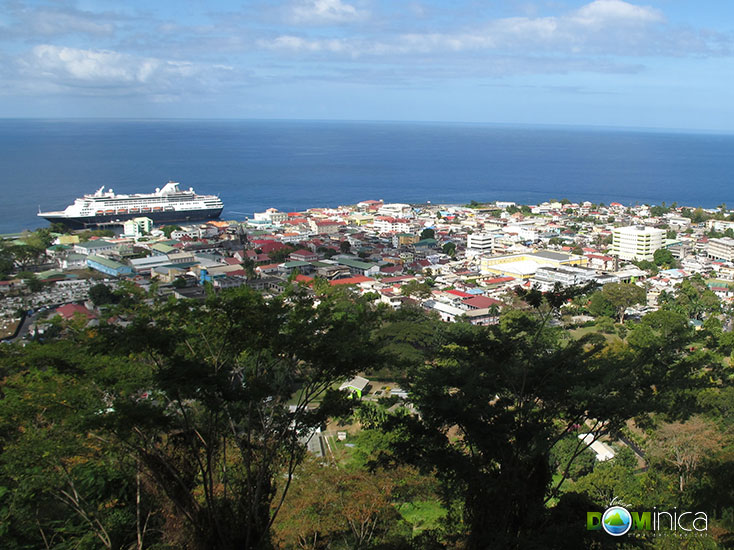
a banana boom. There were into mini-buses for a quick gawp. Cruise-ship
tourists spend little money, cram up the "sites"; and
discredit the government's proclaimed policy to be an "ecotourism"
destination.
North of Portsmouth the road wiggles onwards to Capucin, the
furthermost northern village. A woman and her teenage daughter,
on the way to market, sold me mangos and a pawpaw for almost nothing.
``From Roseau you coming, oui! Mon Dieu. Papa. You walking alone?
Since when you coming to Dominica?" A gangly fisherman, who
joined the conversation, said: "To Capucin, you going. I
personally know, you going Capucin."
The early-morning road was usually empty. A mini-bus (public
transport) might pass, a farmer's pick-up truck, a lorry with
construction workers hanging from the back, or the Japanese saloon
of a civil servant on the way to town. Sometimes there were other
walkers to chat to: school-children in crisp uniforms (like the
sombre little boy who declared: "All white people have cameras");
farmers with machetes and waterflasks; once, two teenagers with
a bleating kid goat apiece draped round their shoulders. But usually
the only sounds were of cooing zenaida doves, chattering yellow
bananaquits or tree frogs. Gentle, rural Dominica.
On my way to Capucin, I met a tall man with no teeth: he told
me he was a retired carpenter, he read the Bible every day and
his brother loved a white woman called Jean who lives in Hackney.
Nearly everyone in Dominica has links with Britain (or more latterly
Canada and the United States). Some who had "gone up"
are now returning to build comfortable retirement homes after
a working life away. They are called returnees or, more colloquially,
"innits", because of their use of a London vernacular.
In one remote spot, I came across a new white, balustraded building
with the sign, Little Venice; the owner had lived near London's
Little Venice; now, back home, he was putting the finishing touches
to his guesthouse.
In Capucin, a breezy village gloriously spread out high above
a sparkling sea, I stayed with Steve and Marvalyn, a young couple
whose tiny, wooden two-room home was decorated with pledges of
love and religious motifs. Religion is a powerful presence in
most Dominican homes. As darkness fell we walked to church for
charismatic Catholic hymn-singing. Next day was Mothering Sunday.
In a shopwindow at Portsmouth, I had seen a poem celebrating Mother's
Day, written by one Sister May. It began: "She shall not
be beaten by the rod; Nor shall she be pierced by the sword".
Capucin was the end of the motorable road where Dominica falls
away in shaven cliffs. The silky grey and blue waters of the leeward
coast give way to a sea that is dark and oceanic. We climbed hard,
past hidden waterfalls. Leo, the guide, was going to visit his
mother for Mothering Sunday, in Pennville, the village at the
end of the trail. We passed the abandoned hamlet of Grand Fond
where Leo had been born. But he had not abandoned his land. There
was coconut water to drink; golden oranges and grapefruits to
eat off mossy trees; newly fallen mangos, pawpaw, bananas, the
over-ripe pods of the cacao. Whatever was in the garden of eden
was in that fairy glade in Grand Fond.
Leo threw some coconuts to his friendly black sows and we moved
on until we reached the road and Reposoir, an old, boarded up
estate house. Dominica's old French coffee and cocoa estates have
names that sound like sighs - Malgre Tout and Temps Perdu. Such
colonial estates were modest affairs: no grandee white plantocracy,
no guaranteed riches from that unpredictable landscape. Dominica
wore the colonialists out. By the turn of the century much of
the land and some influence had shifted in to the hands of the
town merchants, the coloured elite. Foreigners still occasionally
buy land for their dreams; the scoundrels come and (mostly) go;
the best ones stay.
The air was sweet at Pennville. The church had just emptied of
its congregation and the road seemed full of small girls in pastel
tafettas. In the rum shop, where Leo greeted his mother, a massive
lunch of chicken pelau and ground provisions was being prepared
on a battery of stoves. Visitors were welcomed by a smiling one-eyed
woman.
Close to Pennville is the village of Vielle Case, where, in 1646
Father Breton, a French missionary, performed the first mass on
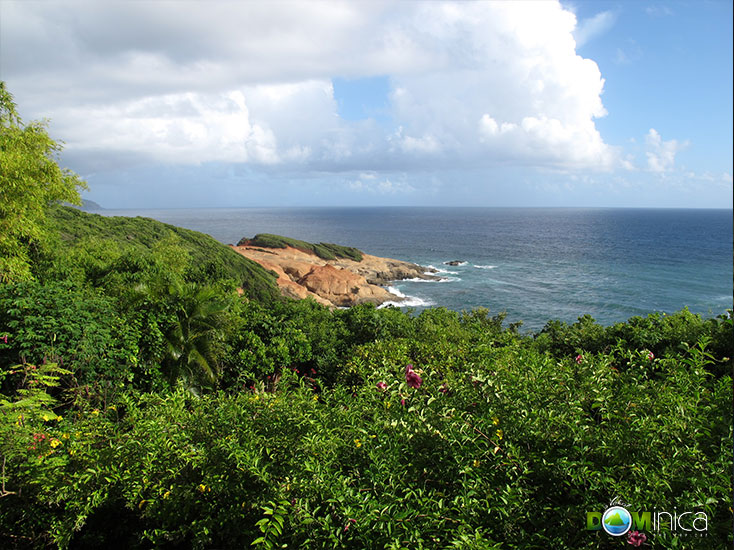
the island. From there, the jagged north coast came into view,
with its red literite rock, occasional white sand beaches, and
"dry littoral vegetation", a Presley quiff of green
swept back by the force of the wind. I was bound for pretty Calibishie,
a fishing village lapped by a sheltering sea, memorable for its
homes garlanded with red hibiscus hedges.
Beyond Calibishie lies Dominica's banana country. One morning
when sky and sea briefly became indistinguishable in their greyness,
I sheltered from the rain (you can hear it before you feel it
as it drums its rythmns on banana leaves) in a banana shed, an
open-sided little wooden hut, with galvanised roof, a sloping
table and bench; bunches of rejected green fruit on the floor.
Those boxes of spotless fruit in British supermarkets have been
packed in one of many such simple sheds: cut green from the plant,
the fruit is carried up and down steep slopes, gently washed and
treated, then packed into boxes. ``A banana is like a baby,''
farmers were always telling me. ``They need constant attention.''
And despite all this care, the price is going down, driven downward
by the greed of American-owned multinationals who demand even
more of their large share of the European banana market.
"When he sell a pound of bananas for 20 cents he cannot
buy a box of matches for 30 cents," said forthright Edith
James, of Marigot, who had been to the post office to collect
a video of Bugs Johnson (?) sent by her brother in Texas. Edith,
who is in her early thirties, took me to her parent's home for
lunch. Most of her siblings are in North America; she has never
worked in Dominica; only when she went away - to the British Virgin
Islands or to Canada -has she found work. If the banana industry
"goes down", the next generation will find it even harder.
The alternative to a legitimate trade is drugs. The Caribbean's
banana islands will, so it is said, be destabilised and will,
as Miss Charles once told me, make Haiti look like "apple
pie".Already cocaine has arrived in Dominica; occasionally
I would see an unlikely mansion fit for a rock star built, I was
told, on the back of the drug trade.
South of Marigot, Dominica's third largest town, the character
of the windward side begins to take shape: the Atlantic hammering
into high cliffs and the occasional wide bay of dangerous currents
and foamy breakers. To landward, there are coconuts and bananas,
beyond a roadside always edged with damp banks of rare ferns and
vines. Here, too, is the Carib Territory, an area of land set
aside for the Caribs in 1903. They are the survivors of the Amerindian
peoples who inhabited the pre-Colombian world of the Antilles;
their mixed descendants live only in Dominica (and St Vincent)
where they farm and fish like any other Dominicans, their ancient
culture most clearly expressed in their basketry and canoe-making.
Carib homes, in the seven villages within the boundaries of the
Territory, are small and neat, the earth swept bare around them.
Carib gardens are brightly planted; canna lilies, roses, yellow
alamandas and hibiscus set against patches of red soil. Kent Auguiste,
a member of the Carib council, has planted his yard with trees
and shrubs associated with Carib traditions. He has a gommier,
for example, the massive tree whose trunk the Caribs have always
used to make their canoes. And herbs for curing illness, and larouman,
a fleshy-stemmed reed, for basket-making.
South of the Carib Territory are the east coast villages of Good
Hope, San Sauveur and Petite Soufriere; they are more isolated
than most, strung along a road that goes nowhere except to Petite
Soufriere. There, like in other villages, old-world courtesies,
quietude, hard work, domestic certainties and no doubt, for some,
boredom, are the constancies that mark the days.
I reached Petite Soufriere on a Saturday morning. Teacher Marjorie
was waiting for me and took me to her pale pink house, surrounded
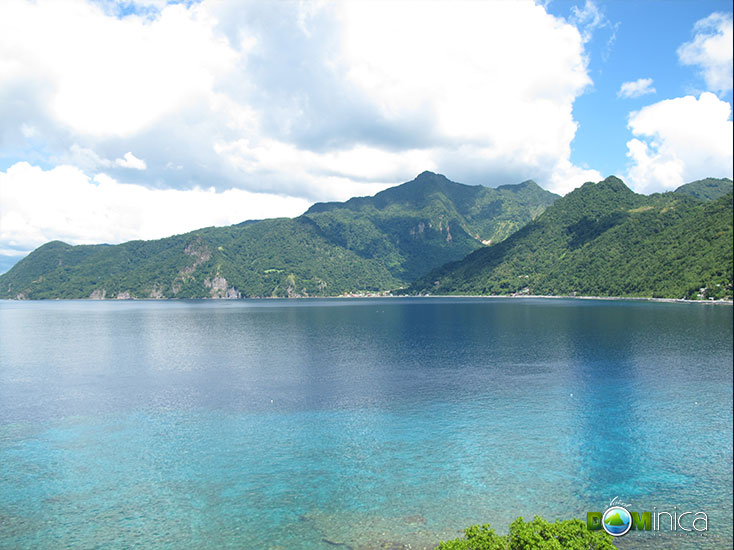
by coconuts and bay trees. Below was a sea of dense blue. Everywhere
smelled of bay. That afternoon Marjorie's teenage son, Eddie,
showed me around the village. We visited Mr Coipel, who was preparing
for next day's Sunday feast of St Isadore, the patron saint of
farmers, when men and women parade to church in national dress
with baskets of fruit and flowers. Then to a friend of Eddie's
who climbed a mango tree for me to taste a particular variety
of fruit. Then across a stream to the home of bandy-legged Peter
Bambou, who has fashioned baskets, brushes and brooms all his
long life. I asked him to make me a conta, a sort of pre-Colombian
back-pack. Then past a fiendishly narrow cricket pitch - the cliffs
rise at mid-off and mid-on - and down to a rocky cove where small
boys were having fun hurling themselves into the roaring waves
in Saturday afternoon abandon.
An old man in an isolated blue and pink wooden house leaned on
his window sill: he had a white plastic telephone jammed to his
ear. A new world has come to this coast only recently: no television
service yet (although there are videos), electricity since the
mid-1980s, and, of course, a road for only the last 30 years.
"Good morning, my lady," said Wylie St John of Boetica,
who was off to tend his cattle. As a young man he either took
his boat, under sail, to Roseau, or he would walk, his produce
on his head, over the mountains, returning the same day. His life
had been hard, the road had brought blessings; and he remained
content: "When I go to bed I have no fear," he told
me.
The last major link in Dominica's road chain is about to be completed,
joining the two south-east villages of Delices and Petit Savanne.
From Delices, I waded across the White River at Pointe Mulatre
where the new road begins its tortuous, zig-zag climb. Inland,
you can look towards the steaming Boiling
Lake, the second largest in the world (to get there is a spectacular
hike). And finally down to the village of Petit Savanne, another
pristine community dominated by baytrees and
bay-oil distilleries.
I was now within a day's walking of Roseau, and I spent my last
night with two Canadians, who have lived in Dominica for many
years; they are building a
little hotel on the edge of their land with its majestic set-piece
view to the village of Grand Bay. Dominicans from other parts
speak of Grand Bay with pride and sometimes alarm. It has its
own mythology, of solidarity and self-esteem. Three times its
people burned down Geneva, the local estate house (the first time
when it belonged to Jean Rhys' family; an event she described
in "Wide Sargasso Sea") in grievance against the owners.
The last time was in 1974.
In the early morning light I walked up L'Allee, Grand Bay's main
street, with its mural of Haile Selassie and Marcus Garvey, with
Rapho Raphael, my guide on the trail over the mountains. Rapho
is a keen local historian and anxious to restore the old sugar
estate workings (cast iron machinery stamped "London and
Derby) at Bagatelle, his own south coast village.
As we walked through trails of bamboo and cool forest, Rapho
told me of Ma Toutou who beat her bele drums on moonlit nights
in the heights of Grand Bay, of his hurricane experiences, and
of how an old slave-built cobbled road had been destroyed much
to the disgust of the Grand Bay folk. Then it was down through
an avenue of ancient mangos, once the windbreaks of E.L. Rose's
lime estate, when Dominica was the greatest lime producer in the
world. Then on into Soufriere, with its sulphur springs, where
a scuba-diving
business has recently opened. There, there were white tourists
in day-glo bikinis. Across the road, an old man sat selling breadfruit.
More meetings of tradition and modernity. More history lessons.
The walk was nearly over and, in the cooler hours of that afternoon,
I set off for the last lap back to Roseau and Cherry Lodge. As
the tropical night fell, I knocked on the door and called to the
owner, Miss Tavernier, "I reach". As Phyllis Allfrey
had written: "Love for an Island is the Sternest Passion."
And in spite of, or perhaps because of, all those "ups and
downs", in rain and sun, my own passion for Dominica had
survived.
© Polly Pattullo 1998
First published in the Guardian newspaper Weekend section on April
4, 1998.
Polly Pattullo is co-author (with Anne John-Baptiste) of The Gardens
of Dominica. For more information visit the Papillote
website.